

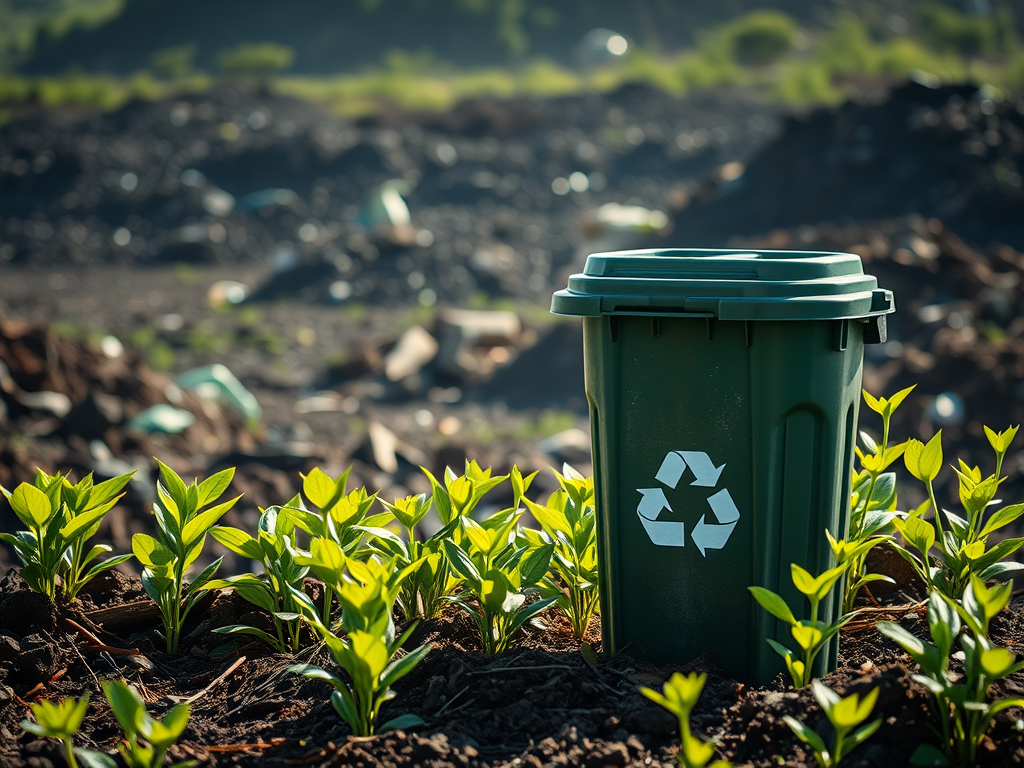
As a wee lad back in elementary school we had a school field trip to a nearby landfill facility to learn about the processes. They had a green house with plants grown using the landfill soil that we were allowed to keep (I think, memory can be an odd thing). That was probably the last time I ever had to think about it. This year as a family we’ve started producing more trash than I was accustomed to, mostly recyclables. Noticing this trend my curiosity awoke.
Some cursory research later and I’m forming an idea of how things are done. Our house is serviced by Republic Services and every week they come to empty a landfill, a recyclable and a yard waste container. After it gets picked up it goes to a transfer station north of here where it’s processed and stored.
Recyclables are sorted and then sent for breakdown and re-use. If you go to Republic’s website they’ll mention their Polymer center which is meant to be a long-term large-scale plastic recycling plant, though it’s not meant to open ’til 2023. Ideally it’d be nice to know where individual plastic types end up, how much of a product really ends up being recycled, and what happens to the non-recyclable material. The truth is probably rather ugly. Most recycling processing plants are actually off-shore and the garbage companies sell what they can for re-processing. Everything else is other stored for a potential sale or re-directed to a landfill. To truly get to the bottom I’ll have to reach out to Republic directly and wait for a statement.
For the landfill, there’s a similar process where it’s sorted at the transfer station and then brought to another landfill site. The closest Republic owned landfill near me is the Keller Canyon Landfill about 15 miles away. By all appearances this is a well-maintained landfill. Even the google pictures show a nearby hill with cows grazing. The most recent issue occurred in 2018 when a contractor falsified radiological data allowing radioactive material to enter the landfill. The cleaning and potential contanimation were treated seriously and the follow-up helped remedy damage. Though this raises the issue of what pressured an indpendent contractor to falsify intentionally and why does Republic use conctractors at all?
Without opening an inquiry with Republic or more serious research I’m left with more questions than answers after all of this. In the end I don’t know how motivated I am to learn just how little we actually achieve with our attempts at waste reduction. I had hoped that I wasn’t as wasteful as I thought but as long someone else takes it away every week it’s not my problem right? It’s far too easy to think like that and I know burying my head in the sand won’t help. This is a real issue and perhaps we’d be better served if I follow-up.
https://www.republicservices.com/blog/yesterdays-waste-leads-to-tomorrows-energy
https://www.republicservices.com/blog/one-persons-trash-another-persons-energy
 ooglykraken