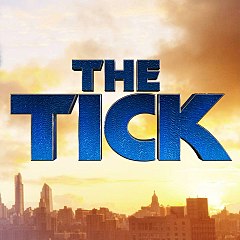
My familiarity with “The Tick” is limited only to the recent Amazon series (2016), not the one with Patrick Warburton, so if it doesn’t follow in the spirit of the original material I cannot comment. However what it does do is make the last decade or so of profuse heroic media look as awful as I think they are (I mean specifically the ridiculous output of Marvel and DC and how not great most of it is). The Tick follows Arthur Everest and his new acquiantance the eponymous The Tick, a seemingly invulnerable blue-suited hero who is pushing Arthur to be a hero as well.
Our giant blue friend The Tick knows little about himself or his own past but is driven by “Destiny” as he calls it, to act as he does. It is destiny in his mind that makes him want to encourage Arthur to take up the mantle of hero and be the best Arthur. Between them they have the brains and brawn dichotomy with The Tick being an overpowered non-intellectual and Arthur a quick-thinking, effective planning, somewhat cowardly squishy person. Arthur being the logic of the duo can’t “hear” destiny as The Tick does but can effectively turn his friend’s desires into plannable actions. It’s here in this dynamic that heroism is explored, in one of many ways. Despite being a regular person Arthur learns to become responsible in taking action, no matter how small, to help others. The Tick is innately called upon by “Destiny” to do this but doesn’t always know the best way. They learn from each other, support each other, and in doing so help others.
There’s more I could write and with time more effectively could I write it but this is just a call to watch what a proper Super-Hero media can be in an era where the pure ideals of yesterday are covered in the equivalent of a child smashing action figures together in ugly CGI “action”. If you do watch this be warned that season two ends in a cliffhanger(s) and we’ll likely never get a season three.
I remember a casual afternoon at my parents’ house when some of the family had come over to visit. They’ve got enough yard space for the kids to play and my mom enjoys entertaining family and friends. Some family were talking with one of my older cousins and someone had asked “What do you want to do for job?” or something like that. I was in middle school at the time so he was probably in high school . His response was “to make video games” and as he went on about his answer, a lightbulb that I didn’t even know existed popped into existence and lit up at the same time. My cousin is still talking but I’m only half-listening as a line of thought crawls through my brain. I didn’t know you could do that or rather I’d never thought about it. I was aware of game developer’s, Blizzard was a favorite then, but had never considered it from the level of the individual. So right then and there I’d decided I’d do the same. Starting in high school and on through College that was the plan. This was how I got into software development and eventually picked Computer Science as my college major. My sophomore year I heard about a local group called Hoosier Games. I joined them and was shown how little I knew about anything. Somehow I was able to find an Internship for the summer at a local Software and game devolopment studio called Plow Digital / Plow Games located in downtown Indianapolis, Indiana. It was there I was given a crash course in Unity3D and spent the next few months cranking out digital game guides (I worked on the Street Figther IV guide), mobile games, custom interactive experiences, and probably more.
The experience at Plow was really big for me. I worked with a lot of cool, creative people who were unanimously both cordial and driven. They moved into a new office space shortly after I left and I haven’t kept up with them but they still seem to be doing pretty well. My experience there put me back at Hoosier Games but this time leading a small team of seven people to make Katabasis. This was everybody’s first game, and my first time leading a team. While it was never a perfect process I still remember the time fondly and wish the best for the team. We had myself and another who voluteered to code, an artist, and two musicians, while everybody helped with design. Most of the team persisted for a year but after two it became a solo act. Early on it took a while for the identity of the gameplay to come through but our artist had a very distinct style that worked great for the game. Our composers also put together some really interesting tracks. In fact just yesterday I was looking into custom vinyl presses of the game’s soundtrack as this year is it’s fifth anniversary.
The following summer I was able to get a job interning on Marvel’s Video Game Production team. I mainly helped the senior Producers with whatever project, so I bounced around to different games and ended up doing lots of QA and testing when possible. Not everything that came to our desk was a game build sometimes it’s concept art or in-game art, design documents, pitches, and more. Being an organizational nut I organized the spare office space and cleaned up the shared digital documentation. The latter was an extended effort to catalogue Marvel character’s first appearances and confirm other similar historical questions. While there I worked on a variety of projects like the yet-to-be released Spiderman for PS4 and some others. It was a great team but I never belonged, way too friendly and social. The position itself is also too people focused for me, but it did give me some managerial insight.
I would go on to continue on some other solo projects but had largely disconnected from Hoosier Games in my waning time as a college student. This was mostly due to some fortune in acquiring a position under one of the professors doing freelance game development. This position lasted about a year until it transitioned into Water Works, an educational game being developed through the IU School of Public and Environmental Affairs. This was a web-based game and thus a bit of a departure from my usual work. Not only that I was picking up what was left as someone else’s passion project. This was where the majority of my game development time went until I left college.
After moving out to California’s Bay Area to be closer to a couple of different studios I started interviewing around, trying to connect on LinkedIn, and doing contract work. I met some really nice people in the area who gave me some great advice but I eventually gave up and started pursuing my Plan B, Software Engineer. A silver lining I suppose.




 ooglykraken