Burnt + Self-Flagellation

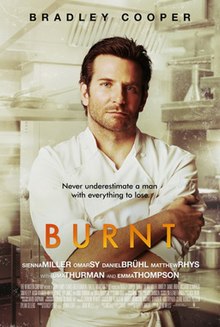
In the movie Burnt, we start at the end of Bradley Cooper’s character’s self-imposed punishment of shucking 1,000,000 oysters. By the end of movie we know his self-flagellation is proven to have no effect on anyone really but himself and his sins against the world still need atonement.

This mirrors a similar ascetic journey I undertook as a college student, where I also underwent a self-imposed flagellation. While I was situationally poor I took it to the extreme and would forego eating up to a week at a time and skip sleeping for days at a time, this lasted for months. I hoped that this penance would bring me some greater clarity concerning life and my place in it. All I really learned is a short path into psychosis complete with auditory and visual hallucinations. The kind of self-loathing that convinced me this was ok was great fuel for excercise and I pushed myself so hard I eventually fractured my foot running, an occurrence that helped end a life long habit of exercise. Obviously such powerful motivation is desireable but not at the costs it took. There is something useful in self-deprivation of desires, not needs, but in all things moderation is important.

By the end of Burnt Cooper’s character doesn’t become better because of his self-flagellation but because he learned to accept his mistakes, he learned gratitude (even in the hands of his opposition) and as a result he became a more complete person. Emotions are powerful motivators but if you don’t manage them properly they can just burn you.

House M.D.

Somehow a show about “medicine” and “doctors” is more about psychology than anything. The clear pathology that House displays essentially every episode would never ever be allowed. If one were to take any of this seriously then it only works in perspective if all the characters are Jungian shadows in House’s head engaging in some sort of cerebral self-examination.

The Shadow allegory holds more strongly in the first few seasons as a person only has so many shadows. However even the patients could be seen as problems for House to solve as a means to incrementally examine his knowledge, beliefs, and experience while moving towards reality. This is mostly just me making high-minded examinations while I watch entertainment television which ironically has its own diegetic dumb day-time television doctor show, a meta-acknowledgement of its non-reality. Though for me this is how I have fun watching television, scrutinizing it and trying to pull some greater meaning out of what is essentially, entertainment. With absolutely zero medical experience it’s not like the constant volley of medical terms has any real meaning to me nor should it be used as a replacement for real world medical knowledge. Which is why I think the character’s constant need to psycho-analyze each other is reflective of the real focus of the show: psychology and sociology. In the end that’s all one can really hope for that at least it’s fun to watch and watching House be House in House is fun.

Just to entertain possibilities, House could be seen as a doctor who’s lost themselves in their Vicodin addiction and he’s making his way through it by working at a mind palace, the hospital, populated by shadows who are projections derived from real people in his life. Wilson is his conscience though being house’s conscience means he too has his own problems. The various female characters like Cuddy or Cameron are tokens of his sexual objectification, desires, and inability to treat them like actual people. Though he doesn’t treat anyone like real people, even though he wants to heal his patients, they are more puzzles than people. Someone like Foreman or Chase are who he could’ve been or couldn’t be and uses them as more counterbalances against his inherently arrogant expertise.

The Death of Friendship

(This was something I meant to publish in October but felt it was a little too depressing to riff off of the ‘horror’ tide around Halloween.)

While not of the gory variety there is an existential horror within the dying embers of old friendships. Expicitly none of my friendships are truly dead but it’s hard to ignore how thin some have become. At no point am I blaming or pointing fingers, if nothing else my awareness of this state but lack of long-form action could justify blame levied at me; but blame doesn’t shift reality.

Before I knew I’d be a father I agreed to be a best man at a friend’s wedding. I think the exact words were “I’d be honored.”. Later as the date approached I had to call and let him know I couldn’t make it as I’d be taking care of a baby then. In between those two conversations we hadn’t chatted once and I was telling him I wouldn’t make it and that I would soon be a father at the same time. He’s a chill guy and seemingly wasn’t bothered by the change in circumstances.

Obviously my communication skills aren’t that great but there’s more to it than that. We’ve been friends since middle school but went to different colleges and while he stayed in Indiana I moved to California. We even both became software engineers, but given our differing choice in college we developed new social groups. There is a stereotype that once you get married or have kids you can’t have friends, and maybe there is some truth there. However I’d guess the truth is much closer to: as people go through life they have evolving circumstances that influence their availability, ability, and willingness to engage. For example after I moved to California and got a good job my ability to visit family increased as I made more money but my availability decreased since I didn’t have many paid vacation days. If this is true then the “death” of my friendships isn’t as much my fault as it is consequence of living my life, making it all the more tragic.

Pushing past the bleakness there’s a couple more things of interest. Though the relationship may feel tenuous you’re still friends just not as close as you used to be. So, again, it’s not a true “death” but the extreme awareness in disparity between then and now. I’m sure if I reached out to my friends we could chat, catch-up, maybe play some games and have a great time. The friendship still exists.

Breaking the Habit

Perhaps I was just in the right frame of mind, but I was reflecting on how over-exposed I allow myself to be to those things I enjoy. For as long I can remember I’d played video games nearly every day usually much more than I should have. This also extends to film, TV or music. While games require participation to function these others do not so I could always fill my time with them even if it’s little more than ambient noise. Thus, over years this became less a conscious choice and more a habit. Having, over the years, indulged in alcohol and seen what happens when over-indulged it made sense to ‘quit’ playing games, watching movies, or listening to music just as I might quit drinking alcohol. By the time I had decided to do this several days had gone by being busy with my daughter, maybe making the choice easier. With my wife out of town for work I became a solo dad and couldn’t afford to indulge. When she came back I could but realized I shouldn’t. That was at the beginning of December and while I now decompress at the end of the day with some TV and listen to music during my morning exercise, I still haven’t played video games.

It’s funny for me to think that this may be the first time I’ve spent so long away from gaming since I was maybe a child. Even in my roughest college semesters putting in 80-hour weeks I found time to play then, but now I don’t. This isn’t going to be an indictment of gaming but an examination of ‘breaking the habit’ of playing and what it’s like, for me.

First and foremost, I’d like to point out my mental and emotional stability
is obviously not as stable as one would like but I do try to do better. That
said I’d been playing games consistently since I was young, began smoking weed in high school, and began drinking in college. For all that time it might be said I was distracting and self-medicating myself and after a week or two
without it my head felt like a room full of people shouting over each other.
Once that started the first few days were the worst. My attention was
constantly jumping, and I had trouble remembering what I was doing. Breathing exercises, journaling, and keeping a to-do list helped in the beginning (and still does) but after a while instead of maybe 30 voices it was down to three. Then two. Now it’s usually just a single line of thought with occasional interjection. I’ll try to avoid any armchair psychology or speculation but here are my thoughts.

I’m finally growing up. After an extended adolescence through my late 20’s I’ve finally had the self-control and will to try and be an adult…. all the time, as opposed to just when things need to be done. I have a schedule for when I exercise, when and what I eat, and never sit down to rest if there’s ‘easy’ labor to be done around the house. ‘Easy’ labor being started laundry, folding it, running the dishwasher, picking up clothes and other things out of place, etc. Basically, anything that takes less than five minutes of effort. Instead of playing games when I have ‘free’ time it’s now spent reading, writing, and preparing to change jobs. This has revived my passion for stories and writing in general. I did try to write two trashy young adult novels as a middle schooler but gave up because they were dumb and trashy. Now I have a full ten-chapter book planned with world building, character arcs, and historical research in effect. Already I’ve got the first chapter written with editing left to do. While it’s hard to focus sometimes journaling and lists keep me on-track. Not to say I’d left all this labor to my wife previously but now it’s a seamless single-person process to do it all and have it always done every day. I think what this really means is that these addictions I had were crutches I relied on when I needed to face the world but instead found a way to shield myself from it, in them.

At best this may be self-aggrandizing or at worst a self-indictment but by sharing I hope others can turn a critical eye to habits in their life and how those habits affect them both daily and over time. (If a certain Linkin Park song comes to mind while reading, yeah that’s intentional).


Splinter Cell

This past October my family came to visit and see my newborn daughter who was about three months at the time. While we did spend a lot of time around Zelda, my daughter, they needed some time outside of the house. My wife and I were, and still are, quite house bound as we navigate the difficulties of everyday life with a new little person to care for. Only just recently have we started going out to eat, something my wife really enjoys. In fact, the first time we took the baby to a restaurant was when we met my family at a local Mediterranean spot. All this to say is they needed to do their own things while here as we were/are boring.

My obvious game collection in the living room held a part of family history though, that being the Splinter Cell series on the Original Xbox. What makes this so important is that my father who’s avidly a non-gamer of any kind (board games, card games, etc…) seemed to gravitate to it and beat the first three in a couple of days each. For such a thing to happen, was for my young mind, something to boast. To this day these games are heralded as classic stealth games, requiring patience, awareness, and effective planning. If you don’t have any familiarity with stealth games, they often provide several approaches, violent vs. non-violent, seen vs. unseen. The hardest way to beat them is usually what’s called a ‘ghost’ run where you proceed all the way with zero enemy casualties and always unseen. My father beat all three almost entirely as a ‘ghost’. Not because the game asked him to but because that’s how he wanted to play the game. I don’t think I’d be able to do that personally even with years of gaming experience, and yet he comes in and does because that’s what was fun to him. Obviously, this made a strong impression when I was younger, so when I started collecting, I made sure they made it into my collection. I did so not only because of their status as stealth classics but because they were artifacts symbolizing a shared appreciation with my father.

Long segue aside while here he eventually decided to pop the first one in. Even though my setup to play original Xbox games on a modern HDTV hadn’t yet been tested I got it up and running with him five feet away from the screen due to short controller chord lengths. He knew he wasn’t going to beat it, but he wanted to experience it again. The game, Splinter Cell, is still impressive visually but shows its age in the more stilted control schemes of yore. Him being able to pop it in and experience that nostalgia is one of the reasons I have a collection. It’s a window into my past, his past, and gaming’s past. It’s certainly not a cornerstone of our relationship but to be able to bond over it then and now is a magical thing. This is what games have always been about for me. Experiencing something with others, sharing in that experience, and holding onto those memories formed through it. He played for maybe 90 minutes before he had his fill and that’s ok, it felt gratifying to me. As though my collection was finally fulfilling its purpose of sharing those memories.

The Christmas Truce of 1914

British and German soldiers conversing

I’m not a historian in any capacity but I do have an appreciation for it. Before World War II the first one was called The Great War. WWI was only a few decades removed from major conflicts in other parts of the world but the change in military technologies became so profound that the countries who participated didn’t want something so grievously terrible to happen again. Ironically this union of countries convening to create a peace would lead to WWII as predicted by some like John Maynard Keynes in his book “The Economic Consequences of the Peace”. All this to set the stage that WWI was so brutal many agreed some forms of combat are too atrocious. This kind of arbitration between rivals makes me think of how military uniforms were implemented largely to prevent unnecessary deaths from friendly fire.

In 1914 something magical happened on Christmas Eve. After months of torrential battle, where leaving the trench and entering No Man’s Land was likely death, in the calm of night some Germans began singing Christmas carols. The English hearing this also began to sing and finally decided to meet in the middle. While the battle lines extended across multiple fronts with soldiers from multiple countries engaged in different areas this seemed true of most of the war front. Whether it occurred Christmas morning or the day before people of different nations decided instead of shooting each other they could sing, play soccer, trade cigarettes and booze, offer services like haircuts, and help their enemies in retrieving the fallen. While there were engagements in various parts of the war line it appeared (according to journals) that most everyone decided enjoying a holiday was worth the (very severe) admonishment of superiors. This unofficial truce is maybe the only in (known) history. Even in the dimmest of times sometimes the better parts of ourselves can prevail over the worst. I just wanted to spread hope and cheer for the holidays and even if you don’t celebrate Christmas, I hope you can appreciate this bit of history. To more honestly represent the situation I sourced some details from this History.com article.